If you were Singapore's chief planner, how would you design the city?


Join YueTu as you step into the URA Urban Planning Museum and embark on a challenge of designing future cities.
After arriving in Singapore, many children notice an interesting phenomenon:
Here you rarely see haphazardly built structures; you rarely see congested roads; residential areas, schools, parks, and shopping malls always seem to appear exactly where they are needed.
Therefore, the YueTu tutors would always ask the students a question:
Do you think all of this is a coincidence?
With this question in mind, we stepped into the "brain" of Singapore's urban planning – the Urban Redevelopment Authority City Gallery (URA).
Here, children will not only be visitors, but will also become future city planners.
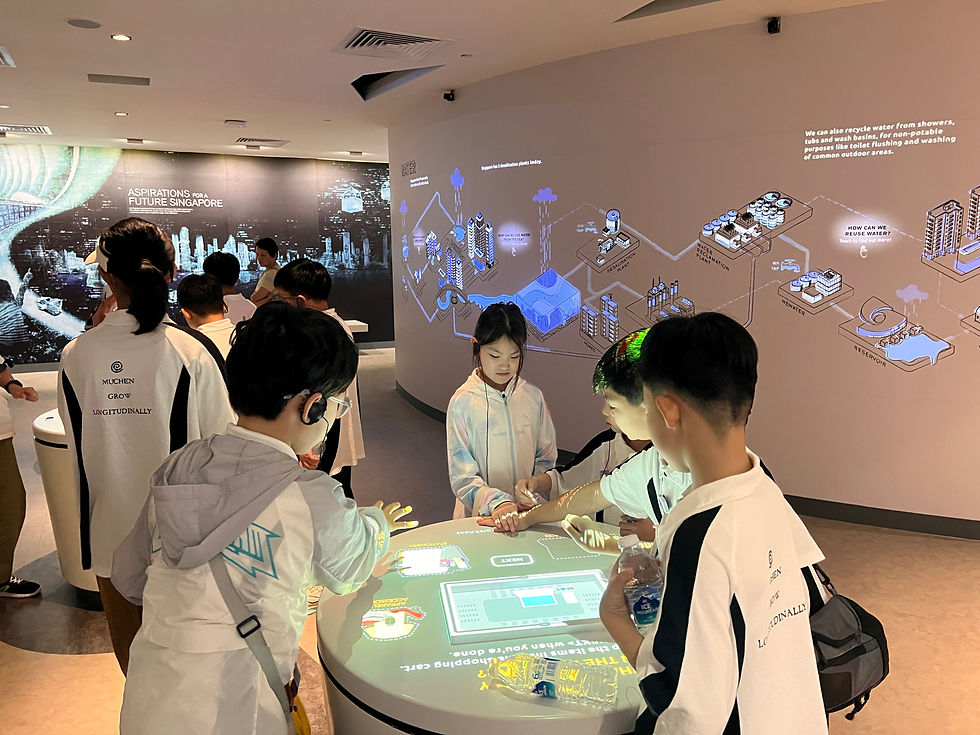
The first challenge: Finding the most important place in Singapore
Upon entering the exhibition hall, a huge model of the city of Singapore comes into view.
At this point, the YueTu instructor will not immediately begin the explanation.
Instead, the students were given an assignment first:
Finding the Core Challenges of Cities
Please find the following in the model:
✓ Where is Singapore's financial center?
✓ Where is Changi Airport?
✓ Where is the port?
✓ Where is the government office area?
Why has Marina Bay become a new landmark today?
Children need to use their observation skills to find the answers in the model.
After completing the task, the instructor will lead everyone to reveal the answer.
In this way, students will discover:
It turns out that the development of a city is not something that happens randomly.
The functional positioning of each area has been planned and designed over a long period of time.

The second challenge: If you were the mayor, where would you build the schools?
Upon arriving at the residential planning exhibition area, the instructors will pose a real-world question:
"I Am the Mayor Challenge"
Let's say you own a piece of vacant land.
You need to build a new community that can accommodate 100,000 residents.
How would you arrange it?
School?
metro station?
Hospital?
garden?
shopping mall?
Many students initially place the shopping mall in the most central location.
But after discussion, they will find that:
It turns out that urban planning needs to consider more than just convenience.
Also need to be considered:
Traffic efficiency
population density
Security
Environmental protection
Future Development
At this moment, the children truly began to view problems from the perspective of urban planners.

The third challenge: What to do when there isn't enough land?
Singapore has a limited area.
But the population continues to grow.
So here's the question:
Land Crisis Mission
What would you do if Singapore's population increased by 1 million in the future?
The tutor will guide students to observe:
Reclaimed land area
Underground space development
High-rise residential design
Mixed-use buildings
Then the students were asked to discuss in groups:
"If you were a planner, how would you solve the problem of land shortage?"
This is the first time many children have realized:
It turns out that a country's development is inseparable from resource management and long-term planning.

The fourth challenge: Unraveling the secret to Singapore's traffic-free environment
In the transportation planning exhibition area, instructors will guide students to observe the Singapore MRT route map.
Then a mini-game was played:
10-Minute Traffic Designer
Suppose a new urban area is about to be built.
You need to design a transportation system.
You would choose:
A: Build more roads
still
B: Build more public transportation?
Why?
After the discussion, the mentor shared Singapore's development experience.
Through comparative analysis, students will understand:
A truly advanced city is not one where everyone drives.
It's about encouraging more people to use public transportation.
Final Challenge: Designing Future Cities
After all learning tasks are completed, the YueTu instructor will organize the most important study tour activity of the day.
The Challenge of Future City Design
Each group of students will receive a city planning task card.
The tasks include:
Planned residential area
Planning School
Planned commercial district
Planning Park
Planning transportation system
At the same time, various unexpected situations will also be encountered:
What if the population suddenly increases by 20%?
What if the land area decreases?
"What to do about increased traffic congestion?"
Students need to discuss and complete their own city design plans together.
Finally, the group presentations and Q&A sessions will take place.
The children gained more than just knowledge about urban planning
Many parents believe:
Urban planning is far removed from children's lives.
In fact, what children learn here are the most important skills for the future society:
✓ Logical thinking
✓ Systems thinking
✓ Teamwork
✓ Resource Management
✓ Problem-solving ability
These abilities are far more important than simply memorizing a few points of knowledge.
YueTu Mentor's Message
At YueTu, we firmly believe:
True study tours are not about moving the classroom to tourist attractions.
Instead, it turns the real world into a classroom.
When the children stand in front of the huge model at the URA Urban Planning Museum
They saw more than just tall buildings and roads.
What they saw was:
How a country plans for the future
How a city changes people's lives
And my future self,
Could I also become the one who changes the world?
